
Buy Online Travel Accessories from BuyBestBrands.in in Association with Amazon India
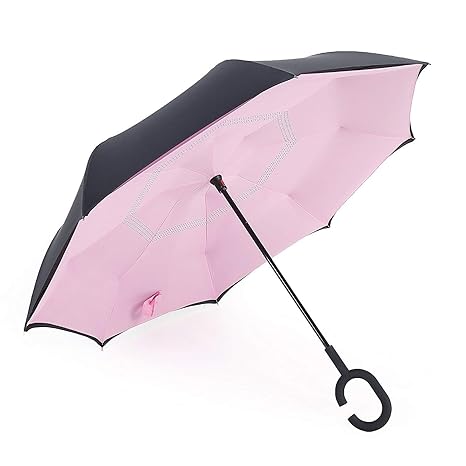
Home » Bags & Luggages » Luggage » Travel Accessories » Shoppozone Double Layer Inverted Reversible No Drip Umbrella with C Shape Handle - Multi Color

Product Description :
The umbrella is 86cm is length and the canopy length is 106cm. The stick umbrella is at a convenient height to carry around and when opened the canopy is large enough for two people. The umbrella does what it is meant to do - give cover from rain, wind and sun! The umbrella is double layered, the outer layer is black and the inner layer is colored.The structure of the umbrella is extremely durable and has been thoroughly tested against fierce winds/ storms and heavy rain. The umbrella comes with a carry case that has a sling around it for easy carry. What is unique about this umbrella -well (unlike conventional umbrella) when you close the umbrella the outer layer is folded on the inside! Even after use on the rain, you will hold a dry umbrella! The advantages of this umbrella Rather than dripping water when a conventional umbrella is closed and put away, the the wet used side is on the inside of the umbrella the outer layer of the closed umbrella remains dry Solves the problem of poking people with an umbrellas spokes because it opens from the top rather than the bottom With its unique way of closing the umbrella it reeks of convenience especially when you want to get into the car The ribs and spokes are in between the two layers of the canopy that gives the umbrella a very stylish look
Product Details :
- Item part number: 6849
- ASIN: B07D5XMF8G
- Date first available at Amazon.in: 18 May 2018
- Average Customer Review : 3.3 out of 5 stars 27 customer reviews
- Amazon Bestsellers Rank: #4,842 in Bags, Wallets and Luggage (See Top 100 in Bags, Wallets and Luggage) #133 in Umbrellas
Product Features :
- FREE STANDING: Self Standing Design enables it to dry and store in very little space
- HAND FREE GRIP: Unique C-type rubberized handle to keep you hands free to do other important things
- NO DRIP: Inverted Design Prevents Water From Dripping, Keeps the Floor And Cars Dry
- DESIGN: Innovative double layer windproof design inverted umbrella with smooth air flow to avoid the umbrella from bending and breaking
Compare With Similar Items



Price:  399
399
 1299
1299
399
1299
You Save: 900.00 (69%)
900.00 (69%)

Baggage or luggage consists of bags, cases, and containers which hold a traveller's personal articles while the traveler is in transit. A modern traveller can be expected to have packages containing clothing, toiletries, small possessions, trip necessities. On the return trip, travelers may have souvenirs and gifts. For some people, luggage and the style thereof is representative of the owner's wealth and status. Luggage is constructed to protect the items during travel, either with a hard shell or a durable soft material. Luggage often has internal subdivisions or sections to aid in securing items. Handles are typically provided to facilitate carrying, and some luggage may have wheels and/or telescoping handles or leashes to make moving them easier.
Trunk - A wooden box, generally much larger than other kinds of luggage. Trunks come in smaller sizes as in the case of footlockers and larger ones called steamers. These days trunks are more commonly used for storage than transportation. Items large enough to require a trunk are now usually shipped in transport cases. Some of the better known trunk makers are Louis Vuitton, Goyard, Moynat, M. M. Secor and Leatheroid.
Suitcase - A wheeled or non-wheeled luggage, as well as soft or hard side luggage.
Train case - A smaller, box-like, handled case for personal grooming articles.
Garment bag - A style of luggage that folds over on itself to allow long garments such as suits or dresses to be packed flat to avoid creasing. Garment bags come in both wheeled and non-wheeled models and are usually one of the largest pieces in any set of luggage.
Tote - A small bag, usually worn on the shoulder.
Duffle bag - A barrel-shaped bag, almost exclusively soft side, is well suited to casual travel, with little organization inside.
Carpet bag - Travel luggage traditionally made from carpets.
Packing Cubes - Small rectangular bags of different sizes and different colors created to keep the baggage organized and save space
Gate Check Bags - Bags specially designed to protect frequent gate checking items, such as strollers and car seats.
Luggage features
Locks - locks serve multiple purposes; a deterrent to dishonest airport workers and locks also help keep baggage closed during handling. Since 2003 most locks integrated into luggage use the TSA Lock standard developed by Travel Sentry to allow opening by the US Transportation Security Administration.
Expandable luggage - suitcases that can be unzipped to expand for more packing space.
Wheels
Luggage carriers - light-weight wheeled carts or harnesses on which luggage could be temporarily placed or that can be temporarily attached to luggage - date at least to the 1930s, such as in US patent 2,132,316 "Luggage carrier" by Anne W. Newton (filed 1937, published 1938). These were refined over the following decades, as reflected in patents such as US patent US2509575A by Herbert Ernest Mingo - Device for the handling of trunks, suitcases, and the like.
The first commercially successful rolling suitcase was invented in 1970, when Bernard D. Sadow applied for a patent that was granted in 1972 as United States patent 3,653,474 for "Rolling Luggage".The patent application cited the increase in air travel, and "baggage handling become perhaps the single biggest difficulty encountered by an air passenger", as background of the invention. Sadow's four-wheeled suitcases, pulled using a loose strap, were later surpassed in popularity by suitcases that feature two wheels and are pulled in an upright position using a long handle.
These were invented in 1987 by US pilot Robert Plath, and initially sold to crew members. Plath later commercialized them, after travelers became interested after seeing them in use by crew members, and founded the Travelpro company, which marketing the suitcases under the trademark "Rollaboard". The terms rollaboard and roll-aboard are used generically, however. While initially designed for carry-on use (to navigate through a large terminal), as implied by the analogous name, similar designs are also used for checked baggage.
More recently, four-wheeled luggage with casters has become popular, notably since their use by Samsonite in the 2004 version of their signature Silhouette line. These are otherwise similar in design to two-wheel roll-aboards, with a vertical orientation and a retracting handle, but are designed to be pushed beside or in front of the traveler, rather than pulled behind them. These are often referred to as "spinner" luggage, since they can spin about their vertical axis.
Sadow attributes the late invention of luggage on wheels to a "macho thing" where "men would not accept suitcases with wheels".Others attribute the late invention to "the abundance of luggage porters with carts in the 1960s, the ease of curbside drop-offs at much smaller airports and the heavy iron casters then available."
Hand luggage (carry-on)
Passengers are allowed to carry a limited number of smaller bags with them in the vehicle, these are known as hand luggage (more commonly referred to as carry-on in North America), and contain valuables and items needed during the journey. There is normally storage space provided for hand luggage, either under seating, or in overhead lockers. Trains often have luggage racks at the ends of the carriage near the doors, or above the seats if there are compartments.
There are differing views between North America and Europe in relation to the rules concerning the amount of baggage carried on to aircraft. In North America there is considerable debate as to whether passengers carry too many bags on board and that their weight could be a risk to other passengers and flight safety. US airlines are beginning to introduce weight and size restrictions for carry-on baggage. Whereas in Europe, many airlines, especially low-cost airlines, impose what is commonly known as "the one-bag rule". This is a restriction imposed to stop excessive weight on board and airlines claim that this policy allows them to speed the boarding of the aircraft. Airports in Europe have mounted a campaign with the European Commission in an attempt to overturn these hand luggage regulations. They claim that it is affecting their duty-free and other airport retail sales and is reducing their revenues.
Smart luggage
Smart luggage is baggage that has a built-in or a removable battery within. It often includes features designed to help with travel, including GPS tracking and USB ports to charge electronics. Some bags include a WiFi hotspot and electric wheels for personal transportation.
Several smart luggage companies have shut down as a result of a ban which came into effect in January 2018 on smart luggage with non-removable batteries being carried as check-in luggage on flights.
Baggage claim/reclaim
In airport terminals, a baggage claim or reclaim area is an area where arriving passengers claim checked-in baggage after disembarking from an airline flight. At most airports and many train stations, baggage is delivered to the passenger on a baggage carousel.
Popular Categories on BuyBestBrands.in
Garden & Outdoors : Seeds, Plants, Plant Containers, Gardening Tools, Garden Decor, Pest Control, Barbecue & Outdoor Dining, Solar Power, Fertilizer & soil, Watering Equipment
Amazon Brand : Symbol, Inkast Denim Co, House & Shields, Jam & Honey, Solimo, Presto!, Symactive, Eden & Ivy, Vedaka, Tavasya, Myx


